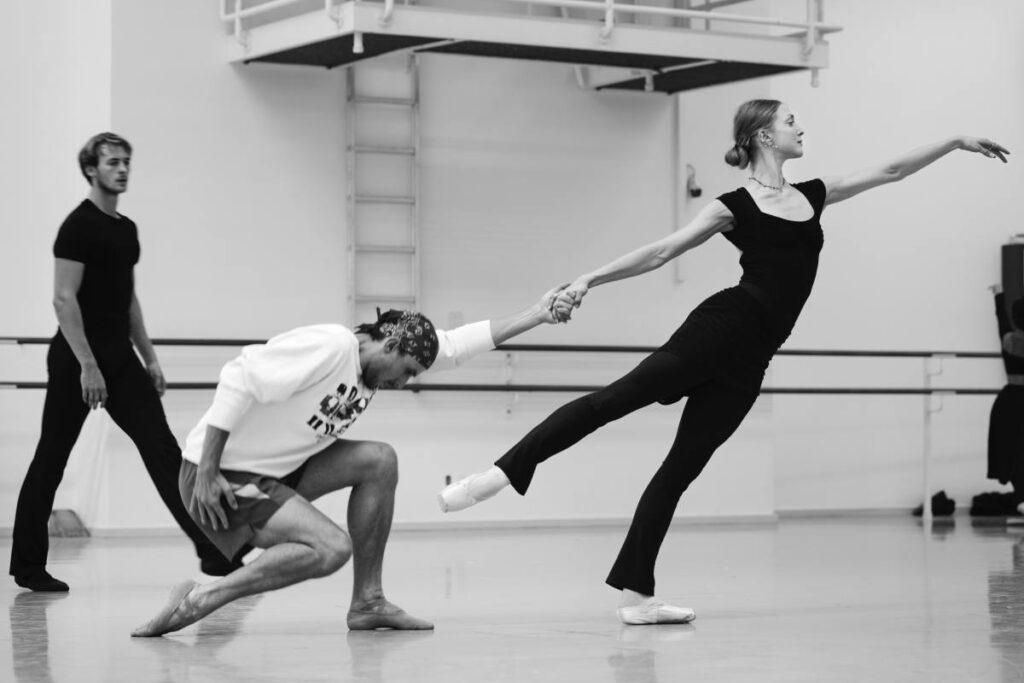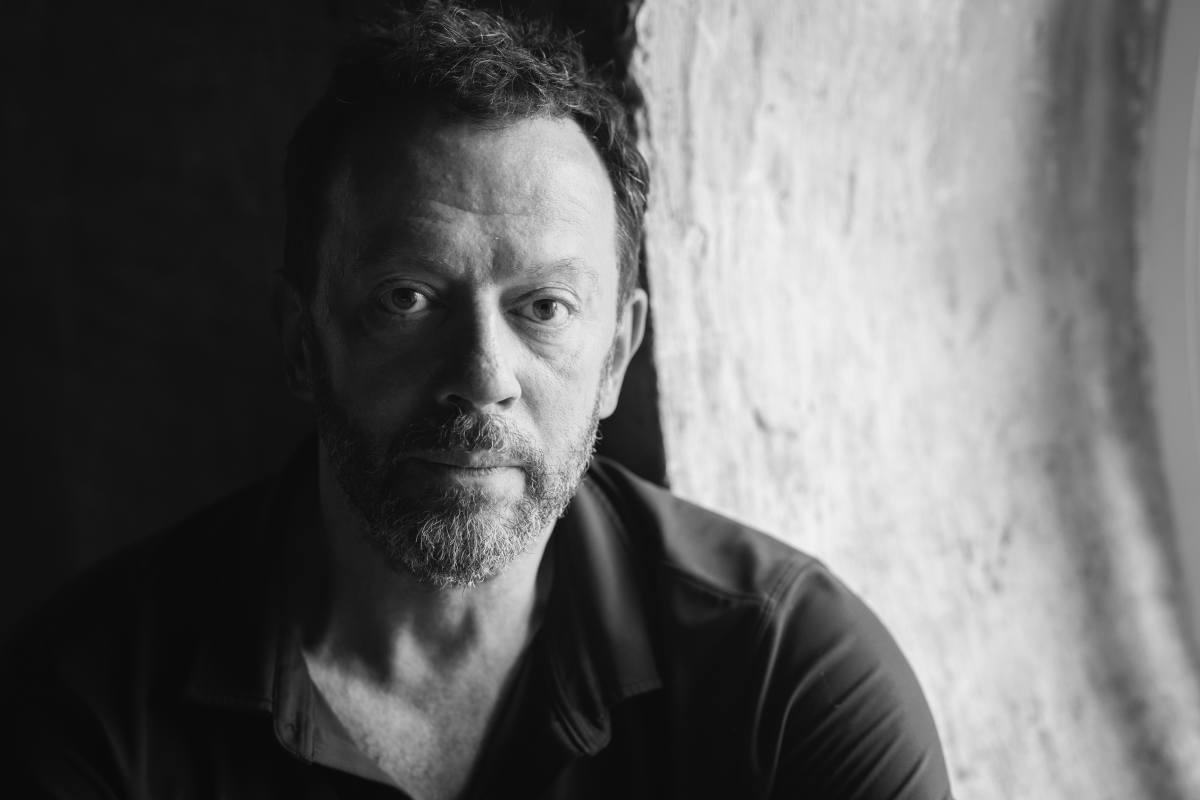
The following are selected, edited excerpts from a transcript of the talk with Alexei Ratmansky that I moderated for Ballettens Venner (the Danish Ballet Society) in connection with the upcoming premiere of Ratmansky’s new work, The Art of the Fugue.
The talk, which also included Ratmansky’s biographer Marina Harss and Royal Danish Ballet soloist Philip Duclos, took place on Wednesday, October 22, at Operaen in Copenhagen.
Set to Bach’s incomplete musical work of the same name, The Art of the Fugue is a full-length ballet which Ratmansky began at the Bolshoi Ballet in 2022. Following Russia’s full-scale invasion of Ukraine on February 24, 2022, he left Moscow with the ballet unfinished.
Since August 2025 he has been re-creating and completing the work for the Royal Danish Ballet, which will premiere it on Saturday, November 1.
Ratmansky shares his thoughts on the new work and on how Russia’s war of aggression has reshaped his view of his time in Moscow, severed ties with former colleagues and friends, clarified questions of identity, and affected his choreography.
I also ask whether ballet is dying, about the inspiration he draws from his studies of antiquity, and about his years dancing in Copenhagen, 1997–2003.
********
About August Bournonville and the Royal Danish Ballet
Alexei Ratmansky was a principal dancer with the Royal Danish Ballet, 1997–2003 (ed.).
“Bournonville… That was a reason for me to come to Denmark: to learn the style. Because this is a classical style that’s not French, not Russian—different. Another part of our genre, of our art, that I was anxious to learn.
“I don’t think foreigners were allowed to step into the repertoire that easily. We had to spend time learning the style, taking classes. We had special classes for foreigners every week. And all these wonderful old teachers were very pleased with my wife Tatiana’s and my desire to learn at their hands. Flemming Ryberg and Mia Vessel taught us—mostly them.
“I don’t think the Danish dancers were obliged to take those classes, but foreigners had to. Maybe eight or ten dancers.
“People joined the company for different reasons, but I think it was absolutely correct to invite dancers from abroad to look closely into the style. That’s the DNA of the company.
“It’s really, really difficult for a foreigner to get this stuff right. I tried so hard. And I remember being corrected all the time: ‘Relax, relax, relax. Yes—this way. Not that way. This way.’
“We saw the Napoli bridge (in a video excerpt; ed.). In Denmark, you stand on that bridge from when you’re six or eight, growing up watching the dancers of the Royal Danish Ballet and then doing all those enchaînements that Bournonville created and his pupils wrote down.
“Then you get this right, because the trick is to be very strong but so relaxed you show no effort. For me, that was the hardest thing. I tried really hard, but I don’t feel I got it.
“Still, it was a great time. I started with Tarantella and little variations, and then I got to dance James in La Sylphide, which was huge.”
About his Relationship with Russia
“I think I need to explain. Russian music and Russian art history were very much part of my mind—of how I understood what I wanted to do as a choreographer. I was proud to be in the line of Russian choreographers abroad. When I arrived in New York, I was greeted by the Balanchine people as part of that lineage, and it felt so, so fantastic.
“The war that Russia started against Ukraine in 2022 changed my understanding of who I am and what matters for an artist—completely—because it was something no one could imagine would happen.
“The connection between Ukraine and Russia was so close. Even though Ukraine—Ukrainian territory, Ukraine as a country—was under the Russian Empire before the Revolution, and under the Soviet empire during the 20th century, it seemed that nothing truly terrible could happen.
“Yes, there could be misunderstandings and so on, but the crimes Russia has committed since 2022 are impossible to comprehend. It’s impossible to understand how a country with such a rich culture, with people who grew up listening to Tchaikovsky and reading Tolstoy, Dostoevsky, and Pushkin, can commit these crimes.
“You know, it is a dictatorship. Of course it’s dangerous in Russia to protest, but they seem to be spiralling back into the darkest time of Stalin. It’s hard for me to find the right words…
“As a choreographer—as someone who listens to music, chooses subjects for ballets, prepares premieres—this door for me is closed.
“I think back and realize people I worked with so closely for so many years are fine with these murders, with these crimes, with this stealing of children, with this destruction. Today, this morning, the news was that a Russian missile hit a kindergarten in Kharkiv—children injured, people killed. That happens every single day. And life in Russia continues as if none of it matters.
“So I shut that door. I lost my best friends. I lost all connections with the theaters. The Bolshoi and the Mariinsky continue performing my works despite having no licenses.
“They erased my name as choreographer. The Bright Stream—you showed a picture of it—they performed it five times on the Bolshoi’s own tour to the Mariinsky. There is no choreographer listed. It says, ‘A version of the Bolshoi Theater.’ I am non-existent there. And they are non-existent for me as well.
“I thought you could only read about this kind of situation in books about Soviet times. It’s back.
“Thinking about my life and work in Russia—and my upbringing, being from Kyiv—you see moments that at the time seemed not to matter, but all those points now connect to the developments that led to this horror.
“You understand: oh, that’s why that happened. That’s why those words were said. That’s why those reactions happened.
“In ballet we’re, of course, so concentrated on working on the body, looking at yourself in the mirror. We rarely look outside. And if you’re focused on your career as a dancer or choreographer, it’s a 24/7 focus on your body and your time on stage.
“Looking back, I see that I, my colleagues, many creatives in Russia, turned away—ignoring the signs: Putin and his mafia gaining power, cutting freedoms, shutting TV channels, killing opposition leaders for years and years, starting in the early 2000s, when Russia seemed to be joining the world in progressive, democratic development.
When you created ‘The Bright Stream’, it was a ballet of hope?
“That ballet played with the aesthetics of pre-war Soviet culture. And it was about reconciliation, in a sense—because the original Bright Stream from 1935 was banned by Stalin, even though it was a huge success.
“The creative team was in deep trouble because of official criticism. For me, The Bright Stream was a homage to Shostakovich; to the choreographer who was censored and didn’t have a career after his brilliant beginning, Lopukhov; and to Adrian Piotrovsky, who was sent to a Gulag and killed a couple of years after the premiere.
“At the time I created it, that felt like a distant past. We could look at the aesthetics of that era and smile with some understanding, even a bit of nostalgia—because our grandparents were building this ideal society, those who believed.
“There were not many cynics, as now. Now, in Russia, you can get information—you know what’s going on. But at the time of The Bright Stream, I don’t think people had any information at all. There were very, very few who could tell you the truth. Sorry—my vocabulary isn’t enough to speak on these terms.
“I can speak much more easily about ballet. This [war, politics] has been a very, very big part of my life for the past couple of years.
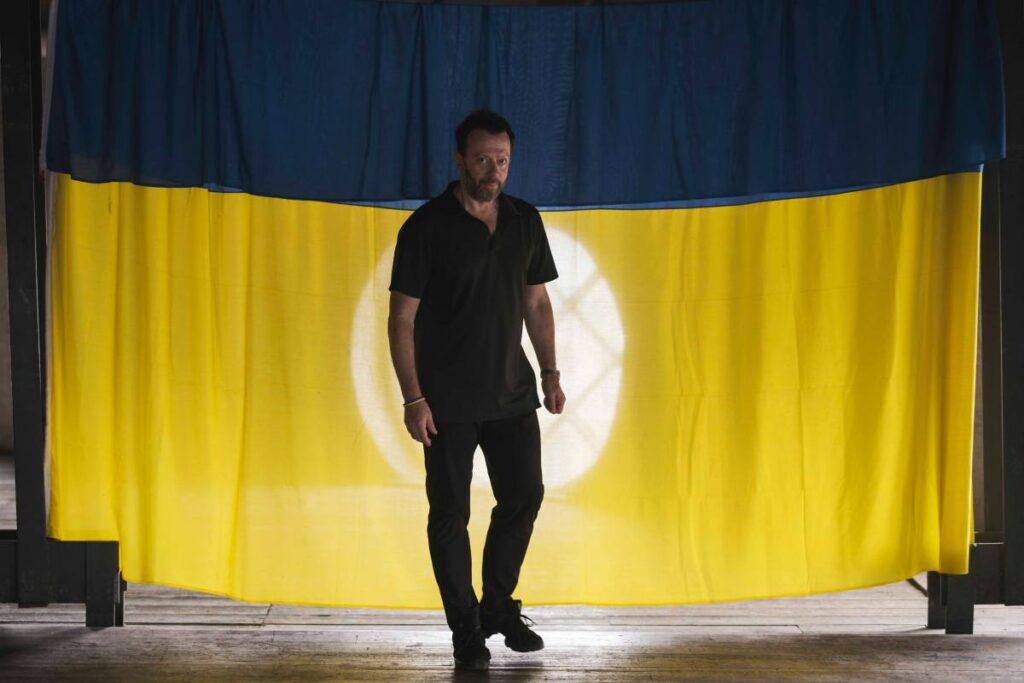
“I think everyone is aware of it. It’s beautiful to see so many Ukrainian flags in Copenhagen. I think Denmark supports Ukraine like no other country in Europe.”
About Solitude
Created for New York City Ballet in 2024, ed.
“This piece was hard to make. There was a picture I saw in the news—in the summer of 2022.
“This is maybe one of the first wars so thoroughly documented. Every day you see pictures of destruction, of death, of suffering. Everything is recorded.
“And there was one picture I couldn’t forget: a missile hit a bus stop in Kharkiv and a little boy was killed. The photograph showed the father holding the hand of his dead son. He sat there for hours, unable to move.
“I struggled at the beginning. I didn’t think it was right to go into that territory and present it as performance.
“Then I thought of using Mahler—which, of course, tears your heart apart, because it’s Mahler. The dancers’ support was extraordinary. I didn’t tell them the story, but they had seen posts online. They understood the weight of the piece—what I was trying to say.
“It consists of two parts. In the first, the hero sits motionless for ten minutes—which is actually very difficult physically, because he must then stand up and dance full out. It’s set to movements from two Mahler symphonies. The ballet runs about twenty minutes.
“I had never made political comments in my ballets before the war. And this isn’t something you can force—you can’t say, ‘Okay, I’m doing a ballet about the war; now look, react.’ But the picture wouldn’t leave my head. And as a father, I connected to that moment.
“While Russia is bombing Ukraine, ballet companies—as well as opera companies, orchestras, drama theaters—keep working, keep performing. There are air-raid sirens and bombardments every day. They stop the performance, go to the shelter, and then sometimes cancel the rest or return and continue. These performances are so popular you can’t get tickets—people need them. And in such times you understand it is ‘not just for pleasure,’ as it says on the proscenium at the Royal Theatre. It really means something now; to see that ballet, music, theater are necessities in times like this.
“I admire Frank Andersen—he staged La Sylphide and Flower Festival in Kyiv. And choreographers like Hans van Manen have given their pieces; they’re rehearsing Forsythe now.
“Half of the company left. I’m talking about the National Opera of Ukraine in Kyiv, my home company. A couple of weeks ago there was very heavy shelling of Kyiv. I saw a post from a soloist holding his cat, the building behind him completely destroyed. It said, ‘I have no more apartment—it’s gone—but I saved my cat.’ And the first thing he did was go to the theater to rehearse and perform that evening. That is the life of my old community in Kyiv—and in other cities of Ukraine.”
About Kallirhoe and the Inspiration from Antiquity
‘Kallirhoe’ was created for American Ballet Theatre under the title ‘Of Love and Rage’ in 2020.
“The music is by Khachaturian—the Armenian composer of Soviet times who wrote Spartacus. We all know this music. He also wrote another ballet, Gayane, an extraordinary score, but the story—Soviet propaganda—is impossible. So we had to find another subject. And my friend, the French actor Guillaume Gallienne, said, ‘Have you read this story? Kallirhoe—it’s the oldest surviving romantic novel.’ I had never heard of it and had never met a person who had read it.
“It’s a very complex story, but in a few words: it’s about the most beautiful woman on earth, and every man she meets falls in love and wants her for himself. When it premiered in New York in 2020—I think—the timing was not great; it was the height of the MeToo movement, and there were many complaints that the subject was not appropriate.
You have a very serious interest in Antiquity. Where does that come from and how does it influence your choreography?
“It actually goes back to my time in Copenhagen: I was at the Glyptotek. I had always looked more toward… well, painting and sculpture were not my interest. But then I looked at the sculptures—an amazing collection, a beautiful museum, the colour of the walls—and the whole thing… magical. It felt like: this is the essence of what we do on stage.
“The way the bodies shift, how they take flight, the arm positions, the movement that is frozen but not dead—it’s movement in stasis. It was so fascinating it opened my eyes. Since then we’ve travelled to the smallest cities and museums in Turkey, Italy, Greece—and you always find something that blows your mind because it’s so beautiful.
“I think the Greeks discovered the secrets of beauty and began to research them. They found the rules—the rules of harmony. Why this line is harmonious and exciting and that line is not. And that’s exactly what we do on stage: we look for the most harmonious, most expressive line. As I said, it’s endless, because each of us has an individual body—but there are rules of harmony.”
Bournonville was a great admirer of the Danish sculptor Bertel Thorvaldsen; he saw him as one of his artistic fathers. He even had plaster casts of Thorvaldsen’s works placed in the studio so the dancers would be inspired.
“I think the students at the Ballet School should study this—study the sculptures, all of them.”
Is “Ballet” Dying?
“I can say I see many performances that give me that impression.
“But I believe the language we inherited—the classical technique—won’t die, because it marries the human body, with its natural curves and imperfections, to ideal geometry. I think that’s a beautiful idea. When I retired as a dancer, what I missed most was that morning moment: standing at the barre doing tendus, dégagés, grands battements. You look in the mirror, but you don’t see yourself—you see the ideal geometry, and you want to perfect yourself. There is no limit to this perfection.
“And then there is the music, which gives the body its style and phrasing.
“The vocabulary is huge. Studying the notations made me realize that what we use now is only a small part of the classical vocabulary—there is much more.
“So I do believe it will continue, and it will inspire choreographers and dancers in the future, as it does now.
“But yes, we see a lot of performances that leave you wondering what it is you’re seeing. So yes and no.”
About The Art of The Fugue
“Back then my idea was to give the Bolshoi—where the style is so presentational—something pure to do. I think half the choreography was done, recorded. And it always felt like… I needed to finish this project.
“When Nikolaj asked if I could make a full-length for the Royal Danish Ballet, this was one of the titles I proposed, and he said, ‘Okay, let’s do that one.’ I was happy, because I wanted to finish it. It’s like carrying a baby and not giving birth—you need to give birth.
“We changed the design—the set is completely different. I changed things I didn’t like in what I’d done.
“And of course the second half of the ballet still needed to be made. I’m still in the process—I have a few minutes left to choreograph—but we’re already having runs on stage. Today was the first time I saw the whole piece from beginning to end, with little gaps to be filled.
“Bach wrote it—it’s considered his last piece. In the original score there’s a sentence written by his son: ‘Papa died,’ written as he was composing. I’ve read that some people doubt the authenticity, but the last fugue is unfinished; it stops in the middle of a bar. That isn’t in question, and it’s a beautiful, profound way to end.
“It’s a little unsettling, because you’re not sure… But Bach didn’t write it for any particular instrument, so we took the liberty of dividing it into five parts, each played by different forces. We have a piano section, a section for a brass group, a third on harpsichord, a fourth for string ensemble, and a finale sung a cappella by singers.
“It’s an exercise—a scientific exercise. The little melody—it’s not even a melody, it’s the idea of a melody. And then Bach does everything possible with the polyphonic development of that material.
“Very challenging music, because there are no big contrasts. It’s a whole world, but it’s flat. Yet at the end it leads you somewhere where the rules of harmony are established by… whatever, whoever. There is something bigger than all of us, than this world and this music. You can hear that. It’s very hard to capture, of course.
“But I think ballet is good at expressing what we can’t put into words. And I’m glad we’re not using words—we’re not.
“Sometimes we feel we need to explain what’s going on, but actually we don’t, because the body leads us into this non-verbal territory. It has meaning, it has sense, it has gravity, it has weight. And it pushes the dancers to explore the purity of movement.
“And we’ve talked about this geometry that is fascinating. In the box of the theatre, under the light, we see the bodies as art forms—art objects.”
“The pas de deux is the only section that hints at a story, or perhaps we make it look as if there is one. We’ve talked about how it’s physical, but there is also the music. The idea is that the music is born from the dancers’ movement. They must be completely together; that’s our focus now—achieving that.
“It’s the most abstract thing I’ve ever done. You can’t hide behind any mise-en-scène or acting; you have to commit to every step.”
About the Instrumentation
“I tried different combinations for the music—I even consulted a Bach specialist in New York—but… it’s random; still, I think it makes dramatic sense.
“I would say this is the most challenging music I’ve worked with. Even though it’s melodic, it has rhythm—and that’s always great for dancing. At the beginning I played with the idea of applying the fugue structure to the dance, but somehow it doesn’t work. It doesn’t work. So the approach is freer in how we present and develop the movement material; otherwise it would be too scientific, too dry.
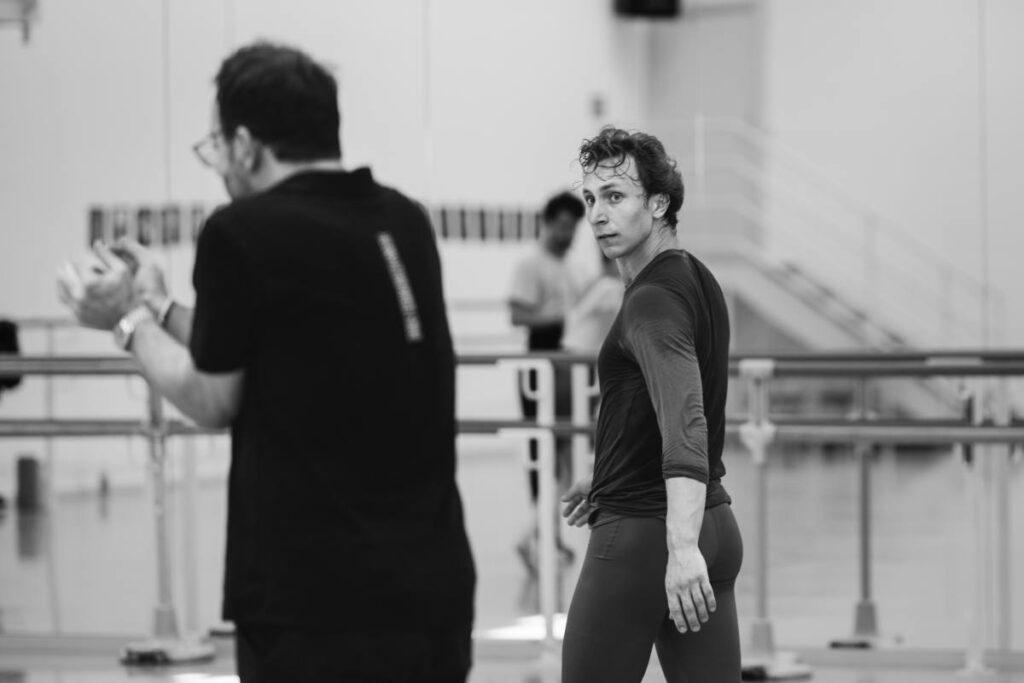
“What we have now—about a week before the premiere—are the designers’ visions (costumes, set, lighting); the dancers with their personalities and artistic personas; my own desire to see certain movements done a certain way; my wonderful assistants, Alex Antonievich from Toronto and Kyle Davis from Seattle; and the artistic staff of the Royal Danish Ballet. We’re combining our efforts and trying to get somewhere together. We’re very curious where it will lead us, and when the public comes, their energy will contribute to what we see in the end.
“The result is unknown. We only understand what it is after it premieres— and even then, some productions take time to reach their potential. Many questions, not many answers yet—but we’ll get there, hopefully.”
It was a dream to experience Bach. Because when you choreograph, it’s like you live with this music for a long time. And I need to hear, and probably other choreographers do it differently, but I need to hear it a thousand times unless, until I get the sense of the movement that I will use for a certain rhythm or passage.
Can you say more about your choice of instrumentation?
“I was afraid the ‘scientific’ side of this music might overwhelm—or diminish—the music itself. It’s an important exercise for me, but I thought I needed to change the sound world to keep the audience engaged. It was a protective step—not to let the audience grow bored with the same dynamics. That was the reason.”
The music has text. Did the text matter when you were making the choreography? And it’s religious text, I believe.
“The text, if I’m not mistaken, is like a question—maybe not exactly a question—to God: ‘Let me see you, Almighty God, forever.’ I think that’s what it says.
“Yes and no. There’s a weight, a gravity, and I think that’s reflected in the steps—but it’s not an illustration. It isn’t. The finale feels like a logical conclusion of the different themes developed throughout the ballet, I think. We’ll see.”
This ballet has been created first with Russian dancer, and now with the Royal Danish Ballet. How has that impacted your vision?
“My years with the Royal Danish Ballet were very important to me. I love Bournonville’s idea of making rhythm with the feet and melody with the upper body. I use a lot of that, and I see the dancers understand it instinctively—it’s their language. But you’re right: some sections were made on completely different bodies, with a different technique. Some steps were challenging for Bolshoi dancers and are easy for Danish dancers—and vice versa.
“In these final rehearsals I try to encourage the dancers to be themselves. They have the material; they need to make it their own. Only then will it work. If I see them fighting the coordination, I’d rather change the steps—make something that highlights their strengths.
“It’s an interesting process to find a common language with dancers from different schools and with different dynamics. Some moments are very important to me, but sometimes I follow what the dancers do and incorporate their ideas and details. That can be very exciting—and lead you into unknown territory.”